




Oct 29,2026
A landing jack is a small part of the trailer chassis only until it fails under a loaded front end, binds during delivery, or arrives with a mounting pattern that does not match the build. This landing jack review focuses on the factors commercial trailer builders, distributors, and bulk buyers should use to judge jack performance before committing to a product line or purchase order.
For B2B buyers, the right decision is rarely about choosing the highest stated capacity at the lowest unit price. A landing jack must fit the tongue or chassis design, operate predictably in field conditions, withstand repeated use, and remain available with matching hardware and related chassis components. That makes the evaluation both an engineering decision and a sourcing decision.
A meaningful review begins with the operating conditions of the trailer. A utility trailer used for intermittent loading does not place the same demands on its jack as an enclosed cargo unit, equipment trailer, agricultural trailer, or a heavy commercial platform. Trailer weight, tongue weight, ground conditions, cycle frequency, and parking duration all affect the required jack configuration.
The first question is capacity, but capacity needs context. A published rating may describe static support, lifting ability, or a particular tested condition. Buyers should confirm what the rating represents and build in an appropriate margin for real-world loading. A jack should not be selected by gross trailer weight alone. The relevant load is the vertical force carried at the front of the trailer, including uneven loading events and the additional resistance created when tires sink or the trailer is positioned on a grade.
A jack can hold a load in a parked position and still be poorly suited to lift that load repeatedly. Gear wear, screw design, tube strength, and handle effort become more significant when operators use the jack daily. For production trailers intended for fleets, rental use, construction work, or agricultural service, cycle life deserves the same attention as the headline capacity number.
Ask for the working load rating, lift range, retracted length, extended length, and expected operating duty. These specifications determine whether the jack will provide adequate travel without forcing operators to block the frame excessively or run the inner tube too near its limit. Excess extension reduces stability and increases the chance of side loading damage.
The jack body may be engineered for a high vertical load, but the complete installation is only as strong as its mounting structure. Weld-on, bolt-on, and clamp-style installations each serve different production needs. The correct choice depends on the frame material, tongue geometry, assembly method, and service requirements.
For welded installations, evaluate weld area, mounting plate thickness, tube position, and clearance for crank travel. For bolt-on designs, verify hole patterns, fastener grades, bracket stiffness, and access for inspection or replacement. A mismatch between the jack and the trailer tongue can transfer load into weak points, distort the mounting surface, or make the handle difficult to use.
There is no universal landing jack configuration. The best product is the one that matches the trailer architecture and the duty profile of the end user.
A-frame jacks are common for light and medium-duty trailers with A-frame tongues. They offer a familiar package, straightforward installation, and practical lifting travel for many utility, cargo, and recreational applications. Their limitations appear when tongue loads increase, service cycles become frequent, or ground clearance and structural support requirements become more demanding.
Sidewind or topwind tubular jacks can be selected according to available handle clearance. This detail matters more than it may seem. A handle that contacts a body panel, toolbox, propane mount, or trailer accessory encourages improper operation and can lead to damaged gears or bent components. In high-volume trailer production, checking this clearance at the design stage prevents repeated assembly changes later.
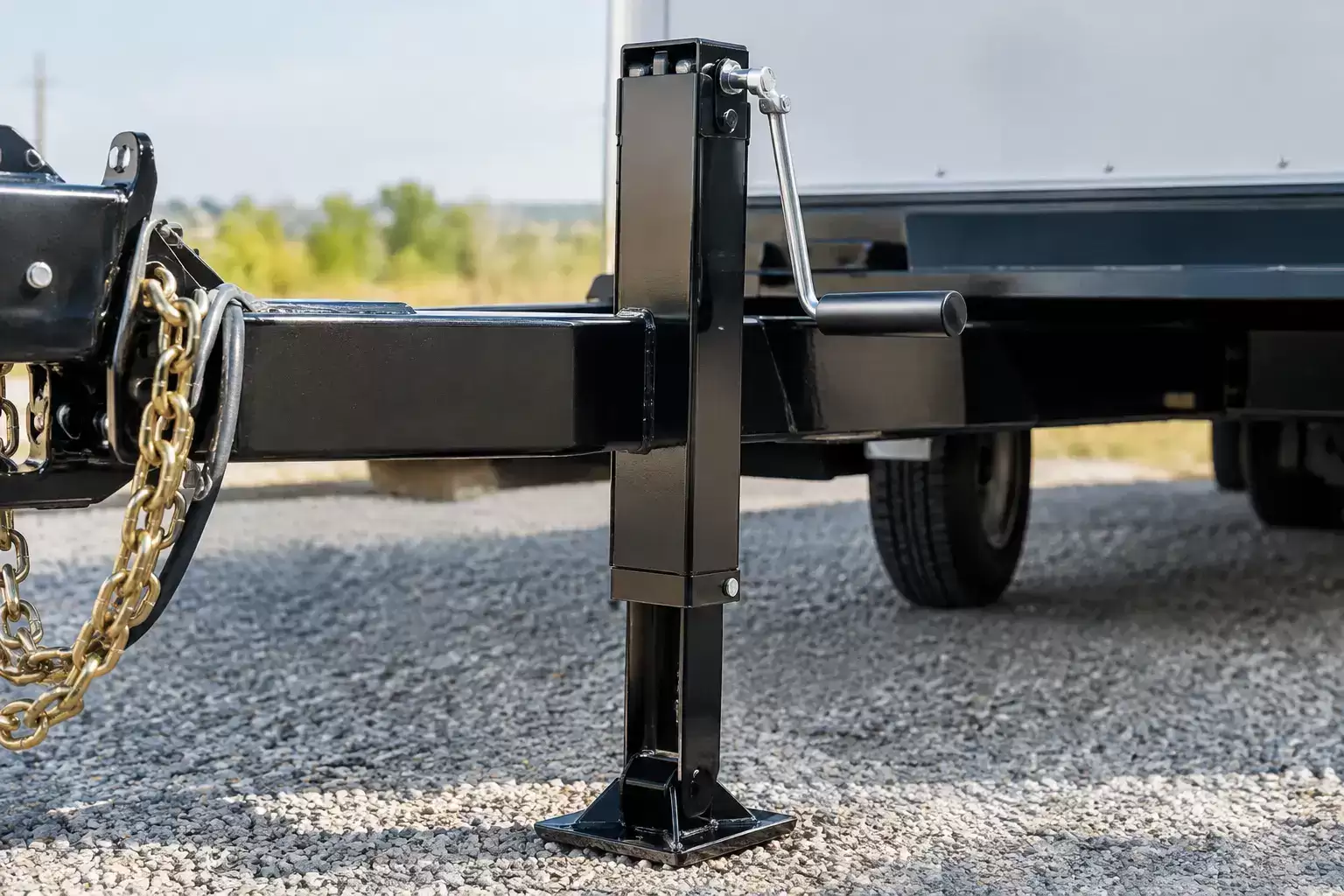
For heavy-duty trailers, square-tube landing gear with drop legs offers greater stability and faster deployment over a large height range. The drop leg handles coarse adjustment, while the geared section provides controlled final lifting. This arrangement reduces cranking time and is often a stronger fit for commercial equipment, high-capacity cargo, and industrial trailer applications. It does, however, require careful attention to leg spacing, cross-shaft alignment where dual legs are used, and adequate frame reinforcement.
A product listing can show capacity and dimensions, but a dependable landing jack is defined by material control and component fit. Tube wall thickness, internal screw quality, gear engagement, bushing design, weld consistency, and footplate construction all influence service life.
The outer and inner tubes should resist deformation under normal vertical loading and expected side forces. Side loading cannot be eliminated completely in field use. Uneven ground, rushed parking, and off-center loading happen. The goal is not to treat misuse as normal operation, but to specify a jack with suitable strength and guidance for the working environment.
Gear design also affects the operator experience. A jack that requires excessive effort may be technically functional but unsuitable for frequent commercial use. Smooth, controlled operation indicates correct alignment and proper engagement between the drive components. Buyers should inspect for backlash, binding, inconsistent travel, and exposed areas where dirt or moisture can enter the mechanism.
Corrosion protection should be selected for the actual service environment. Powder-coated, painted, zinc-finished, and galvanized components offer different levels of protection and visual finish. Trailers operating near coastal areas, on winter-treated roads, or in wet agricultural conditions need a more demanding corrosion strategy than trailers stored primarily indoors. Coating quality is not just a cosmetic concern. Once corrosion attacks moving interfaces, serviceability and safety can decline quickly.
A landing jack review should continue beyond the sample unit. For manufacturers and distributors, the supplier's ability to deliver consistent specifications is as important as the first product inspection. Minor changes in tube size, bracket geometry, handle design, or finish can create assembly delays and aftermarket complications when they occur without control.
Before placing a volume order, confirm these practical requirements:
These details reduce the risk of a jack that fits the approved sample but creates problems on the assembly line. They also help distributors organize inventory around compatible parts rather than carrying isolated products with uncertain replacement options.
A landing jack operates within a chassis system. Its selection affects coupler placement, safety-chain routing, tongue reinforcement, brake breakaway hardware, storage access, and the trailer's parked stance. Treating it as an independent purchase can create avoidable conflicts late in the build.
A one-stop chassis supplier can simplify this work by aligning the jack with axles, suspension hardware, couplers, brakes, and related mounting components. For trailer builders, that means fewer specification gaps between categories and less time reconciling drawings from multiple vendors. Northauto supports this approach with trailer chassis components selected for practical compatibility across commercial trailer builds.
Compatibility also protects aftermarket service. When a dealer or fleet maintenance team needs a replacement jack, clear dimensional records and consistent mounting standards make the repair faster. Standardization is especially valuable for manufacturers that produce several trailer models with shared frame platforms.
A lower unit price may make sense for a light-duty trailer with limited use, especially when the application has modest tongue weight and protected storage. It becomes a false economy when the product introduces higher labor costs, warranty exposure, difficult field operation, or an inconsistent replacement supply.
The total cost decision should include installation time, expected service cycles, coating durability, operator effort, return rates, and the availability of compatible replacements. For a trailer manufacturer, even a small increase in assembly time or field claims can outweigh a modest saving on the purchase order.
The right landing jack is not simply the part that holds the trailer up. It is the component that fits the frame correctly, carries its intended load with margin, operates consistently through repeated use, and supports a chassis program that your production team can build and service with confidence.
